Meeting with participants of the International Research School!
15.07.2026
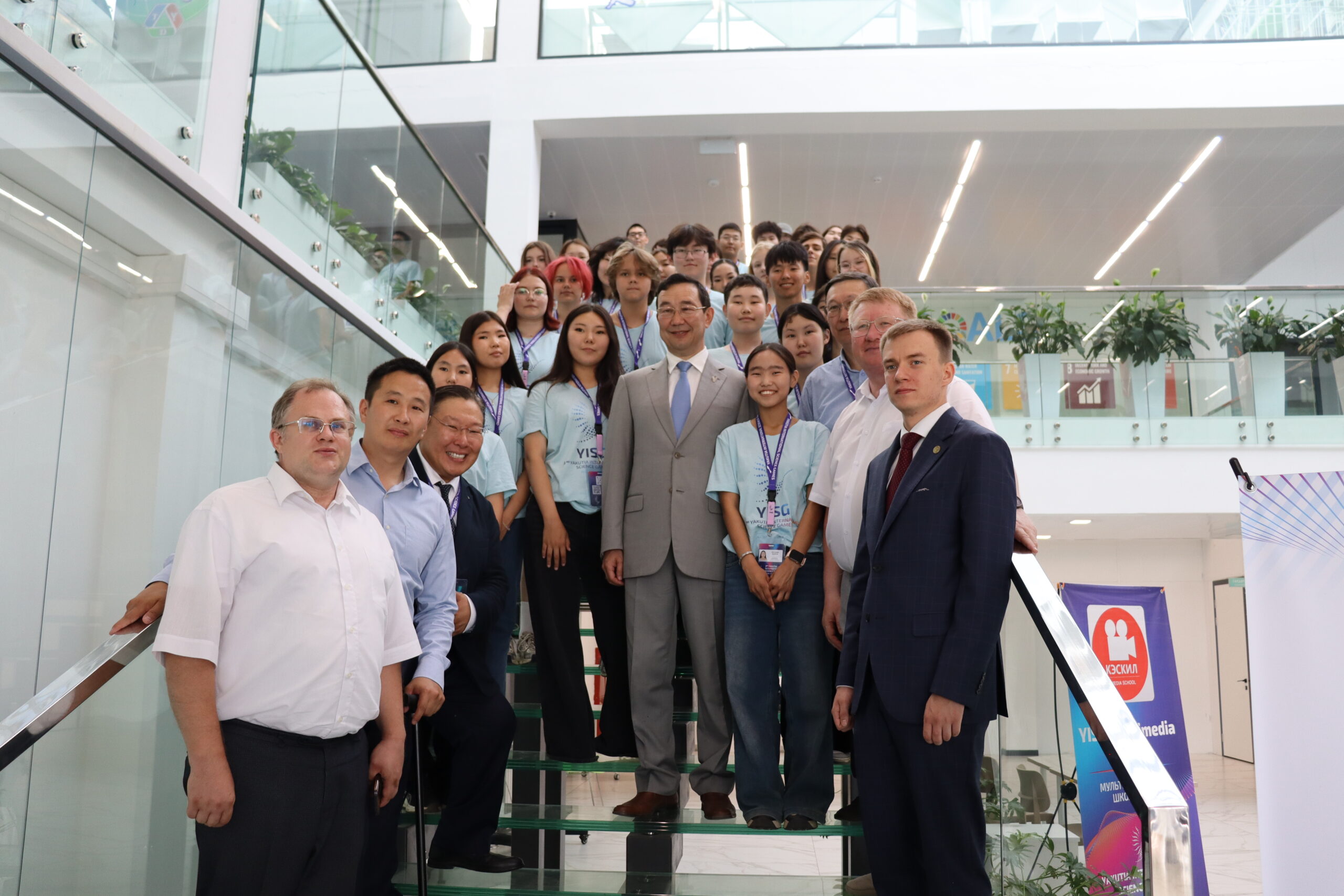
On July 9, 2026, during a working trip to the Khangalassky ulus, the Head of the Republic of Sakha (Yakutia) Aisen Nikolaev visited the Small Academy of Sciences of the Republic of Sakha (Yakutia) in the Chapaevo village and met with participants of the XVI International Research School. Aisen Sergeevich got acquainted with a number of projects.
The project “Echoes of the Pleistocene: comparison of megafauna ecosystems of Central Yakutia and Mexico” was presented by Konstantin Protodyakonov, paleontologist, head of the paleontology department of the BU “Museum of Nature and Man” (Khanty-Mansiysk, Russia), Pavel Nikolaev, master’s student of the Faculty of Biology of M.V. Lomonosov Moscow State University (Moscow), participants: Alisa Smetanina, 8th grade, MOBU “Sakha Gymnasium”, Ivanov Petr, 9th grade, MOBU “Physical and Technical Lyceum named after V.P. Larionova, Dayana Noeva, 10th grade, Municipal Educational Institution “Secondary School No. 26 named after E. Yu. Kelle-Pelle,” and Timur Savvinov, 7th grade, Municipal Autonomous Educational Institution “Secondary School No. 39 named after N. I. Sharin.”
The main idea of the study is to compare Pleistocene paleontological material from Central Yakutia and Central Mexico. Over the course of 10 days, members of the international project team conducted fieldwork in the middle Lena River basin, collected paleontological materials (bones of a woolly rhinoceros and a fossil wolf), and conducted photogrammetry and 3-D modeling. This allowed them to reconstruct the burial conditions of the discovered remains. Using an electron microscope, the participants performed a comparative analysis of the chemical composition of the bones found in Yakutia and those brought from Mexico.
Furthermore, a paleogenetic analysis of the materials from these regions was conducted for a more detailed comparison. The obtained results allowed us to compare the paleofauna of two regions located on opposite sides of the globe: its composition exhibits certain similarities, despite the differences in their ecosystems.
The project “Do-It-Yourself FIRMS: Fire Monitoring Based on Satellite Data with Direct Broadcast Mode” and the Mission Control Center of the Managed Academy of Sciences of the Republic of Sakha (Yakutia) were presented by Artem Mardin, project tutor; Andrey Petrov, chief engineer of the Mission Control Center; and project participants Yuri Arkhipov, 8th grade, Secondary School No. 31 (with Individualized Educational Program); and Stepan Goryavchev, 10th grade, Information Technology Lyceum No. 24 of Neryungri named after E.A. Varshavsky, Aital Zhirkov, 10th grade, MOU “Berdigestyakhskaya Secondary School with UIOP named after Afanasy Osipov,” Varvara Ptitsyna, 10th grade, GNBOU Sakha (Yakutia) “Republican Boarding Lyceum,” Daria Uspanova, 10th grade, MOU “Information Technology Lyceum No. 24 in Neryungri named after E.A. Varshavsky,” and Ilona Fedorova, 9th grade, MOU “Nyurba Technical Lyceum named after A.N. Chusovsky.”
The project “Do-It-Yourself FIRMS: Fire Situation Monitoring Using Spacecraft Data with Direct Broadcast Mode.” Over 10 days, members of the international project team
studied communication methods with the Cholbon spacecraft, calculated the antenna geometry for data reception, and assembled several antennas with different characteristics. Using these antennas, they received postcards from the small spacecraft featuring participants in the 2026 International Space Station (MIS). These postcards were received by radio amateurs worldwide. An antenna was also developed for receiving data from weather satellites, such as Meteor M-2 3. This data was received, processed, and can be used to monitor the fire situation in the region.
Mission Control Center (MCC). The station supports command and telemetry radio links in the 400 MHz and 435 MHz VHF bands. Previously, the station accompanied the ReshUCube-1 spacecraft (M.F. Reshetnev Siberian State University, Krasnoyarsk), and in January 2026, it assumed control of the Cholbon small spacecraft, the first spacecraft in the Sakha Republic. To more effectively manage the Cholbon small spacecraft and support future missions, a Mission Control Center (MCC) with three workstations was established at the station. The new Mission Control Center will enable the control of more complex spacecraft and the simultaneous support of multiple missions. The Mission Control Center will also be used for training purposes during space-related shifts. In addition to spacecraft, the Mission Control Center equipment can be used to operate stratospheric probes, rockets, and UAVs.
The project “Population Genetics: A Tale of Invasion” was presented by Pavel Nikolaev, a Master’s student in the Faculty of Biology at Lomonosov Moscow State University (Moscow). Participants included Arina Protopopova, 8th grade, National Gymnasium “Aiyy Kyyata,” Amelia Leontyeva, 8th grade, National Gymnasium “Aiyy Kyyata,” and Yan Nazarov, 8th grade, State Autonomous Educational Institution “Arctic School” of the Republic of Sakha (Yakutia).
The project is dedicated to studying the genetics of the Yakut crucian carp (Carassius carassius). The Yakut crucian carp is a highly valuable commercial species for the Republic of Sakha (Yakutia), its preservation is important not only for the population’s nutrition but also for the preservation of the traditional fisheries of munkha and kuyur. Currently, an alien but closely related species, the crucian carp Carassius auratus gibelio, is invading the Yakut crucian carp. This poses a risk of the Yakut crucian carp being replaced by the crucian carp or of hybridization between the two species.
Over the course of 10 days, a team of schoolchildren mastered the most modern genetic techniques, which are universally applicable in many fields, from agriculture to medicine: DNA extraction, PCR analysis, electrophoresis analysis, and sequencing. These methods were applied to crucian carp samples caught in lakes in Western Yakutia. The data obtained confirmed the presence of an invasive species and the existence of numerous hybrid forms. The risk of genetic contamination of the endemic crucian carp subspecies was confirmed. Apparently, a range of measures, including the creation of reserves and protected natural areas, is necessary to preserve this endemic crucian carp subspecies.